Showing posts with label Samsung. Show all posts

Wednesday, August 30, 2017

District Court Mulls Design Patent Damages – Apple v. Samsung on Remand

Editor's Note:  The following guest post was authored by Thomas P. McNulty, Counsel at Lando & Anastasi LLP.  

In last year’s Samsung v. Apple decision, the Supreme Court held that the “article of manufacture” for which total profits are awarded upon a finding of design patent infringement may be either “a product sold to a consumer [or] a component of that product.”  The Supreme Court declined to establish the test for identifying the article of manufacture, instead remanding for consideration by the court below.

Given that the Supreme Court substantially changed the interpretation of damages under 35 U.S.C. § 289, it would seem clear that a new damages trial would be required. Nothing in litigation, however, is so simple. Instead, upon remand, the district court considered the parties positions on whether a new trial is warranted.  In the meantime, we will examine the procedural questions addressed by the district court in connection with its order requesting further briefing.

Tuesday, December 6, 2016

Supreme Court Sides with Samsung on Design Patent Damages

On December 6, 2016, the Supreme Court issued a unanimous opinion authored by Justice Sotomayor in the Samsung Electronics Co., Ltd. v. Apple, Inc. case concerning apportionment of design patent damages under 35 U.S.C. § 289. Specifically, § 289 makes it unlawful to produce or sell an “article of manufacture” bearing a patented design and makes infringers liable to the patent holder “to the extent of [their] total profit.” The Supreme Court’s ruling rejects Apple’s argument and holds that the meaning of the phrase “article of manufacture” can refer to a single component within a multicomponent product sold to consumers. In support of its reasoning, the Court cites a similarly broad interpretation of the phrase as previously applied to 35 U.S.C. § 171. The § 171 statute defines subject-matter eligibility for design patents.

Monday, October 17, 2016

Courtroom Sketches from Apple v. Samsung

As a follow-up to last week's post, we wanted to share the courtroom sketches from Apple v. Samsung that were graciously provided by Art Lien of courtartist.com.  Art really captured the look of confusion on the Justices' faces...


Tuesday, October 11, 2016

Eight Telling Quotes from Apple v. Samsung Oral Arguments

So it finally comes to this. After five years of litigation, a dozen appeals to the Federal Circuit, and close to 1 Million tweets, the Apple v. Samsung case goes before the Supreme Court today for oral arguments. The sole issue being decided on appeal is whether an infringer's profits should be apportioned under 35 U.S.C. § 289. Or, as Samsung poses the question - "Where a design patent is applied to only a component of a product, should an award of infringer’s profits be limited to those profits attributable to the component?"

We're lucky to be reporting live from the Supreme Court today as the Supreme Court hears its first design patent case in over 100 years.  For this initial post, we'll be focusing on some of the more telling questions (and answers) from the justices during the hearing.   Continue reading after the jump for some of the more noteworthy quotes and our reaction.

Tuesday, October 4, 2016

Apple v. Samsung - Preview of Upcoming Oral Arguments before the Supreme Court of the United States


After a brief hiatus, nothing helps to kickstart the Ordinary Observer blog like another episode in the Apple v. Samsung saga. This installment, of course, takes place at the Supreme Court with next week’s oral arguments on the all-important apportionment issue. For those who are casually following the case or just need a refresher, we summarize the party positions and key amicus briefs after the jump. We’ll also be reporting from the Court next week so stay tuned for a first-hand account of the arguments and predictions from the courthouse steps next Tuesday.

Tuesday, December 15, 2015

Samsung Appeals to the Supreme Court! ... (but probably won't get there)

It's not every day that the New York Times reports on design patent news.  But when it does, it usually has something to do with smartphones.  

The big news in design patent law today is Samsung's inevitable appeal to the Supreme Court from its August loss (mostly) at the Federal Circuit.  Just last week, Apple and Samsung appeared to finally be putting this lawsuit behind them, when it was announced that Samsung had agreed to pay Apple $548,176,477 to satisfy the judgment entered by Judge Koh and affirmed by the Federal Circuit.  However, in the agreement, Samsung had reserved its right to "reimbursement" if the judgment is reversed.  

In its petition for writ of certiorari, Samsung points out two alleged errors by the Federal Circuit - 1) whether the Federal Circuit should have "factored out" the allegedly functional aspects of Apple's design patents, and 2) whether the Federal Circuit erred by not apportioning Samsung's profits between the profits attributable to the infringing design and the profits resulting from other aspects of the infringing products. 

Of course, Samsung worded the questions presented somewhat differently:
The questions presented are:
1. Where a design patent includes unprotected non-ornamental features, should a district court be required to limit that patent to its protected ornamental scope?
2. Where a design patent is applied to only a component of a product, should an award of infringer’s profits be limited to those profits attributable to the component?
Regardless of how Samsung chooses to articulate the issues, however, a Supreme Court hearing seems unlikely, in the opinion of this author.  

With respect to the first issue, the Federal Circuit did an excellent job of clarifying its own, somewhat confusing precedent from cases like Richardson v. Stanley Works.  In Apple v. Samsung, the court explained that that the functional aspect of a claim may be conceptually factored out as part of claim construction without literally "exclud[ing] those components in their entirety."  See our earlier post on this topic here.  This pronouncement of the law will help simplify design patent claim construction, while emphasizing to juries and judges that designs do not protect functional concepts, only the appearance of an article of manufacture. 

With respect to the third issue, it is highly unlikely that the Supreme Court would attempt to blatantly overrule the clear, expressed wishes of Congress.  Samsung seems to argue that § 289 is just "really old."  But it's unclear why the Supreme Court's analysis of this argument would be any different from the Federal Circuit's:
In reciting that an infringer “shall be liable to the owner to the extent of [the infringer’s] total profit,” Section 289 explicitly authorizes the award of total profit from the article of manufacture bearing the patented design. Several other courts also concluded that Section 289 authorizes such award of total profit. ... The clear statutory language prevents us from adopting a “causation” rule as Samsung urges.
So while its exciting to see design patents in the news, don't hold your breath for the first Supreme Court design patent case in 100+ years.  Of course, we could be wrong and, if we are, we will be the first to celebrate. 

Tuesday, May 19, 2015

After Apple v. Samsung, What is left of Richardson v. Stanley Works?


At long last, the Federal Circuit has handed down its decision in Samsung's appeal from the district court's $930 Million judgment in favor of Apple in the Apple v. Samsung case.  While the decision focuses on both trade dress and design patent issues, this post will focus on the design patent aspects of the decision. With respect to design patents, the Federal Circuit addressed two very important questions: 1) whether Judge Koh improperly failed to instruct the jury to disregard functional aspects of Apple's design patents, and 2) whether Judge Koh erred by allowing the jury to award Apple, Samsung's "total profits" from the accused smart phones.  We summarize these two aspects of the decision, below.

I.  Whether Judge Koh Improperly Failed to Instruct the Jury to Disregard Functional Aspects of Apple's Design Patents

On appeal, Samsung argued that the district court either incorrectly construed the design patent or failed to properly instruct the jury.  Specifically, Samsung argued that in either the claim construction or the jury instructions, the district court should have informed the jury as to which design elements of Apple's phones were functional, and instruct the jury to disregard them.  Samsung pointed to the rounded corners and rectangular screen of the Iphone as being allegedly functional.  

Samsung based its argument on the Federal Circuit's prior decision in Richardson v. Stanley Works, where the Federal Circuit endorsed the idea of "filtering out" the functional limitations from a design patent through claim construction:
The district court here properly factored out the functional aspects of Richardson's design as part of its claim construction. By definition, the patented design is for a multi-function tool that has several functional components, and we have made clear that a design patent, unlike a utility patent, limits protection to the ornamental design of the article. ... If the patented design is primarily functional rather than ornamental, the patent is invalid. ... However, when the design also contains ornamental aspects, it is entitled to a design patent whose scope is limited to those aspects alone and does not extend to any functional elements of the claimed article
Richardson v. Stanley Works, Inc.597 F. 3d 1288, 1293-94 (Fed. Cir. 2010) (citations omitted).

It seems like the Federal Circuit could have simply distinguished Apple's design patents as not including functional design elements.  But, instead, the Federal Circuit attempted to distinguish Richardson in a way that leaves one wondering when Richardson applies, if ever:
Our case law does not support Samsung’s position. In Richardson, the design patent at issue depicted a multifunction tool with numerous components that were “dictated by their functional purpose.” ... But the claim construction in Richardson did not exclude those components in their entirety. Rather, the claim construction included the ornamental aspects of those components: “the standard shape of the hammer-head, the diamond-shaped flare of the crow-bar and the top of the jaw, the rounded neck, the orientation of the crow-bar relative to the head of the tool, and the plain, undecorated handle.” ... As such, the language “dictated by their functional purpose” in Richardson was only a description of the facts there; it did not establish a rule to eliminate entire elements from the claim scope as Samsung argues.
Apple v. Samsung, Slip Op. at 20 (emphasis added).  Based on the Federal Circuit's decision, it is very unclear when, if ever, Richardson now applies.  If the words "factored out the functional aspects of Richardson's design" do not mean "exclude those components in their entirety," then what do they mean?  Furthermore, if the claim construction in Richardson was intended to allow the design patent claim to "include[] the ornamental aspects of those components," then what is the point of "factor[ing] out" functional limitations at all?  

This portion of the court's decision probably creates more questions than answers, and doesn't seem to be necessary, based on the nature of Apple's design patents.  Given the confusing nature of the court's decision, and the apparent conflict with Richardson, Samsung likely has strong grounds for an en banc appeal on this point. 

II.  Whether Judge Koh Erred by Allowing the Jury to Award Apple, Samsung's "Total Profits" from the Accused Smart Phones

Many commentators predicted that the Federal Circuit would take this opportunity to revise the law regarding apportionment of an infringer's profits.  Several law school professors even filed an amicus brief, arguing that § 289 of the Patent Act should be interpreted to require some form of apportionment.  However, the Federal Circuit's analysis on this point was short and sweet:
In reciting that an infringer “shall be liable to the owner to the extent of [the infringer’s] total profit,” Section 289 explicitly authorizes the award of total profit from the article of manufacture bearing the patented design. Several other courts also concluded that Section 289 authorizes such award of total profit. ... The clear statutory language prevents us from adopting a “causation” rule as Samsung urges.
Apple v. Samsung, Slip Op. at 26-27.  With regard to the law professors' amicus arguments, the court dismissed them in a footnote as "policy arguments that should be directed to Congress. We are bound by what the statute says, irrespective of policy arguments that may be made against it."  Id. n. 1.

Friday, December 12, 2014

Apple v. Samsung Oral Arguments, Part I - Functionality and Markman

If you haven't had time to listen to the Federal Circuit arguments in the Apple v. Samsung case last week, don't worry.  The Ordinary Observer has you covered.  We will be examining the arguments in two parts.  Part I will take a look at the functionality discussion that dominated the hearing.  Part II will examine the arguments relating to apportionment.

Samsung began its presentation last Thursday by focusing on functionality, in the context of design patent infringement, and whether the district court was justified in providing the following jury instruction:
If you find by a preponderance of the evidence that the overall appearance of an accused Samsung design is substantially the same as the overall appearance of the claimed Apple design patent, and that the accused design was made, used, sold, offered for sale, or imported within the United States, you must find that the accused design infringed the claimed design.
Samsung complains that Judge Koh failed to "filter out" the allegedly functional elements of Apple's design patents for the jury and failed to offer a jury instruction directing the jury's attention to the "ornamental" aspects of the claim as opposed to the "overall appearance of the claimed Apple design patent":
Kathleen Sullivan (counsel for Samsung): ... As given, the infringement instruction ... instructs the jury to compare the overall appearance of the Samsung and Apple Designs.  Your Honor, crucially, what's missing there is the word "ornamental." You're right that earlier in the invalidity instructions she refers to the term "ornamental."  But the invalidity instructions can't cure the problem with the infringement innstruction.  ... Your honor, we're not saying that there should have been exact, magic words.  We gave her multiple choices, we said "please define the difference between functional and ornamental."  We said "please district court, take out these few things that Apple has admitted are functional..."  As Egyptian Goddess says, the district court has discretion how to distinguish functional from ornamental, but it does not have discretion whether to distinguish functional from ornamental... 
The Court:  What do we do about about the case law that says that your'e supposed to look at the overall design and you're not supposed to just take ornamental features in isolation? 
Sullivan: Your Honor, what you do is say "overall ornamental appearance."  The crucial problem here is that the jury was not instructed to, nor was there any claim construction limiting it to comparing the overall ornamental appearance
The problem with Samsung's argument is that it urges the court to turn the question of functionality, for purposes of infringement (i.e. claim construction), over to the jury.  Obviously, that approach would conflict with the Supreme Court's Markman decision, holding that claim construction is exclusively the province of the court and cannot be handed over to the jury.  

As a reminder, functionality can come up in design patent litigation in two contexts: invalidity and infringement.  In the invalidity context, the question for the jury is whether the design is functional as opposed to ornamental.  If the design is dictated solely by function, as opposed to ornamentation, it is invalid for failing to meet the ornamental requirement of § 171.  In the infringement context, courts sometimes seek to "filter out" functional aspects of the claim as a matter of claim construction.  See, e.g., Richardson v. Stanley Works, Inc., 597 F.3d 1288 (Fed. Cir. 2010).  While some have questioned the wisdom of this approach as improperly dissecting the claim, it remains a contentious issue in design patent law. 

Samsung argues that Judge Koh's instructions were improper because they failed to instruct the jury to consider only the ornamental aspects of the claim and failed to "define the difference between functional and ornamental" in the infringement context.  But such an instruction would have been tantamount to charging the jury with claim construction - here, selecting which design elements were functional and filtering them out of the claim.  In the utility patent context this would be like reading the Phillips case to a jury and then instructing them to evaluate infringement "applying the proper claim scope."  That would be reversible error.

If there was any error in the jury charge, it would have been in Judge Koh's decision not to construe the functional limitations of the claim, at all.  To the extent functionality was really at issue in the infringement context, it was Judge Koh's job to construe the patent, not he jury's.

The Federal Circuit has given conflicting guidance on a trial court's "discretion" in construing "functional and non-functional elements."  In Egyptian Goddess, a case we have addressed several times, the court stated that "where a design contains both functional and non-functional elements, the scope of the claim must be construed in order to identify the non-functional aspects of the design as shown in the patent."  Yet, in the next paragraph, the court also said "[w]e therefore leave the question of verbal characterization of the claimed designs to the discretion of trial judges..."  It is curious that Judge Koh would send the question of design patent functionality (in the validity context) to the jury but simultaneously decline to construe any functional elements of the claim.  If there was a question of material fact as to whether any of the design patents were functional, as a whole, isn't there necessarily a question of fact as to whether individual design elements are functional?

The answer may come down to the extent of Judge Koh's discretion in construing the design patent (or not). Trial judges may have discretion to determine whether the functional limitations, if present, would improperly impact the jury's consideration of the overall ornamental design.  For example, with utility patents, judges are not obliged to construe every conceivably disputed claim term and always have some level of discretion. See U.S. Surgical Corp. v. Ethicon, Inc., 103 F. 3d 1554 (Fed. Cir. 1997) ("Claim construction is ... to clarify and when necessary to explain what the patentee covered by the claims, for use in the determination of infringement. It is not an obligatory exercise in redundancy.").  Judge Koh likely used her discretion to decline to spell out what was ornamental vs. what was functional for the jury if she believed that the allegedly functional elements of the design would not meaningfully impact the jury's determination of infringement.

The Federal Circuit has an opportunity to clarify a district court's discretion in construing a design patent to "filter out" functional limitations.  As with any claim construction issue, district courts ought to be allowed some independence in determining when design patent claim construction is "necessary" or would otherwise be more helpful than harmful for the trier of fact.  This should include the discretion to decline to construe the design at all, even when functionality is at issue in the validity context. 

Tuesday, November 11, 2014

Guest Post - In Apportionment Debate, Design Patents Should Be Distinct

Editor's Note:  The below guest post was authored by Brice Beckwith, a law student at Oklahoma University College of Law.  Brice presented at last month's ABA Design Committee meeting on the subject of apportionment and was kind enough to write up his presentation for the Ordinary Observer.  The ABA Design Committee holds monthly meetings (via conference call) where the members discuss current events in design law and noteworthy decisions.  So sign up and join the conversation!


When I began to look through the Apple v. Samsung briefs concerning disgorgement of total profits under § 289 a few weeks ago, it occurred to me that in many ways the briefs illustrate everything I have come to expect from this area of law. The arguments proceed despite a noticeable lack of recent or direct case law, there is admixture of copyright and trademark policy rationales throughout, and (my favorite) a dependence on late 19th century legislative history as applied to modern smartphones. In my view, the characteristics of these arguments lend credence to the belief that the state of design patent law loosely holds shape as some sort of intellectual property hodgepodge. Nowhere is this more apparent than when reading the arguments that make comparisons between design patent law and other intellectual property regimes. For example, many arguments against § 289’s disgorgement of total profits were similar to calls for a causation/nexus requirement between the infringer’s profit and the infringement. By looking at these arguments we can get some idea as to what makes this area so amorphous, and how that may cause a few pitfalls. 

In its Appellant Brief, Samsung argued for a causation requirement for § 289 based on two premises. First, Samsung, as best it could, stayed within the realm of patent law by arguing that patent infringement is essentially a tort, and that as a tort it requires a proof of causation. To make this claim, Samsung needed both a utility patent case, Carbice Corp. v. Am. Patents Dev. Corp., 283 U.S. 27, 33 (2002), and a copyright case, Mackie v. Rieser, 296 F.3d 909, 915 (9th Cir. 2002). Later, in its Reply Brief, Samsung clarified that this causation requirement would not violate the Congressional intent to abolish apportionment because the requirement would be separate from and precede any apportionment inquiry. See Samsung Reply Brief at 14.  Second, in its appellant brief, Samsung argued for an interpretation of § 289 that would treat an award of profits as a ceiling and emphasized that a causation requirement may already exist in § 289’s language, which states that a patent holder “shall not twice recover the profit made from the infringement.” Relying on another utility patent case, Samsung attempted to bolster this interpretation by tying a lack of causation requirement to constitutional concerns over inappropriately enlarging the patent monopoly raised in Graham v. John Deere Co. of Kansas City, 383 U.S. 1, 5-6, 86 (1966). 

In some contrast, Professor Mark Lemley’s arguments in “Brief Amici Curiae of 27 Law Professors In Support of Appellant Samsung,” took a different road to the same conclusion. Professor Lemely set up trademark law as a close analogue to design patent law in order to show the court a more familiar route it could take when resolving the disgorgement issue. Among several other trademark rules that were offered, was a trademark requirement that a court could award profits only on sales that were attributable to the infringement. See id. at 7. Although Professor Lemley made this point more in passing, it demonstrates a reality in design law that often advocates must reach beyond design patent law for answers.

In that same vein, in a post written on this blog back in August by William Seymour, we can see a similar argument for a causation/nexus requirement stemming from a third body of law. Whereas Samsung chose patent law, and Professor Lemley looked to trademark, Mr. Seymour provided a solution through Copyright law. From his perspective, the copyright disgorgement remedy found in 17 U.S.C. § 504b offers a better analogue to § 289. After comparing the history of the two statutes, Mr. Seymour came to the conclusion that the differences between the two statutes provides strong evidence that the court should not interpret § 289 to allow apportionment. Despite this, Mr. Seymour offered another out for Samsung by pointing to the judicially created nexus requirement for § 504. Under this nexus test the copyright owner must show a legally significant relationship between the infringer’s gross profits and the infringement. Furthermore, the nexus inquiry acts as a threshold requirement before the disgorgement of the infringer’s profits even comes into question. In many ways this solution mirrors what both Samsung and Professor Lemley offered in their respective briefs, and therefore is yet another example of how, in design patent law, the same destination can be reached by taking different paths. 

Taken as a whole, these arguments echo in practice what many commentators propose in design patent scholarship, which is to replace design patent law (either wholly or partly) with copyright, trademark, or some type of sui generis scheme. There is an argument that the very nature of industrial art dictates that the law governing design patents must exist in a space that blurs the lines between other intellectual property regimes. However, these blurred lines may just as likely not be caused by the nature of the thing being protected, but instead by the, long-standing and recently changing, unpopularity of the law. A risk in substituting legal tools from trademark and copyright law is that any independent purpose that design patents once had may be lost somewhere in the mix. Maybe we forget the very reason that design patents were created as a separate entity and, in that forgetting, the replacement of the design patents with other schemes becomes all that more preferable. 

These arguments may also reveal an implicit unease that exists in allowing design patents to be independent from other intellectual property regimes. When faced with rebutting the proposition of a causation requirement, Apple and its amici struggled to find policy rationales that solely belonged to design patents. For instance, in its Appellee brief, Apple rejected any call for a causation requirement on the premise that causation would violate Congressional intent because it essentially equated to apportionment. However, in doing so, Apple avoided making any policy arguments beyond Congressional intent to justify a remedy as severe as § 289. 

In his amicus brief, Perry Saidman made the very same argument that any question of causation equates to a question of apportionment; however, unlike Apple, Mr. Saidman did offer a justification for § 289. Mr. Saidman claimed that one reason design patents require § 289 is because when an infringer appropriates a design patent they are appropriating the “very face of the company.” Id. at 19. Mr. Saidman further noted that when a design patent is infringed the infringers often take more than just product design, rather the infringers in effect misappropriate the very brand of the patent holder. See id. This concern for the protection of brand demonstrates just how blurry the lines in design patent law can be. It is an argument that design patents are unique and therefore deserve a special tool in § 289, but what makes design patents unique in this case is a shared purpose with unfair competition law. In some ways this argument resembles that of Samsung, Mr. Lemley, and Mr. Seymour because it demonstrates the need to incorporate tools and policy from other intellectual property regimes when an immediate answer is not available. 

With these arguments the Federal Circuit has a chance, through its interpretation of § 289, to add some clarity to the amorphous subject of design law. Although the Court must make a skin deep choice regarding apportionment, the more interesting decision may be whether the Court decides to justify its holding uniquely from a design patent perspective or from some other intellectual property regime.

Wednesday, August 27, 2014

Pacific Coast v. Malibu Boats - The Nightmare Apportionment Scenario Realized

Last Friday we commented on Professor Lemley's amicus brief in the Apple v. Samsung case, which addresses the issue of apportionment in design patent law.   Apparently,  Judge John Antoon II of the Middle District of Florida was working on his own "post" on design patent apportionment at the same time.  Last Friday, Judge Antoon issued a decision denying Malibu's motions for summary judgment, including a motion to limit potential damages to the profits for the accused windshields in the case of Pacific Coast Marine Windshields, Ltd. v. Malibu Boats, LLC.  As a result of Judge Antoon's decision Malibu's total profits for the sale of its speedboats will be at risk if they are found to have infringed Pacific Coast's design patent on a boat windshield.  

Here's a graphic to help explain the decision:


You might recall this case from its previous trip to the Federal Circuit, where the court reversed Judge Antoon's decision to apply prosecution history estoppel to limit Pacific Coast's claims against Malibu. While the Federal Circuit held that prosecution history estoppel applies to design patent, the court reversed the district court’s summary judgment of non-infringement because it found that the accused design was not within the scope of the subject matter surrendered during prosecution.


It is unclear why Malibu Boats did not renew its motion for summary judgment on remand.  Although its prosecution history estoppel argument had been defeated, it still had strong non-infringement arguments as a result of the Federal Circuit's decision.  For example, if, as the Federal Circuit says, the accused windshield was not within the scope of the canceled figure,  then how could the accused windshield be within the scope of the remaining figures of the '070 Patent?  The accused design appears to be more similar to the cancelled figure than the asserted design, and that fact might have been enough for Judge Antoon to grant summary judgment. 

Malibu's decision not to renew its motion for summary judgment on non-infringement may cost them. Judge Antoon's decision on Friday was a simple matter of statutory interpretation.  The court found that its hands were tied in light of the statutory history of § 289:

Congress removed the apportionment requirement in 1887, with the enactment of what later became§ 289.  [See Nike. Inc. v. Wal-Mart Stores. Inc., 138 F.3d 1437, 1441 (Fed. Cir. 1998)]. Design patent owners are no longer required “to apportion the infringer's profits between the patented design and the article bearing the design.” Id. at 1442.  The intent of Congress to allow more expansive recovery for design patent owners is exhibited in the plain language of the statute, which allows recovery of "total profit" from anyone who sells “any article of manufacture to which such design or colorable imitation has been applied.” 35 U.S.C. § 289.  In this case, Malibu sells boats, to which patented windshields have been applied. The plain language and intent of the statute support a conclusion that Pacific is entitled to Malibu's profits from the sale of its boats with the windshield.
This reading of § 289 is further supported by Federal Circuit and district court decisions. In Nike, the Federal Circuit referred to the damages as profits from "the infringing shoes" when the patent involved only part of the shoe. 138 F .3d at 144 7. In Apple. Inc. v. Samsung Electronics Co., the plaintiff had several patents pertaining to smartphones and tablet computers that claimed a portion of the design of particular electronic devices but disclaimed other portions. 678 F.3d 1314, 1317 (Fed. Cir. 2012). With respect to damages based on the defendant's profits, the district court ruled that the plaintiff was not required to prove which portions of the profits were earned by the design feature. Apple. Inc. v. Samsung Elecs. Co., 926 F. Supp. 2d 1100, 1111 (N.D. Cal. 2013). "Congress specifically drafted the design patent remedy provisions to remove an apportionment requirement that the Supreme Court had imposed. Thus, there is simply no apportionment requirement for infringer's profits in design patent infringement under § 289." Id.
While Judge Antoon's legal analysis is correct, the case of Pacific Coast v. Malibu Boats is a striking example of the sometimes inequitable result of § 289 in the absence of any equitable discretion in the hands of the Court.  Malibu's boats sell for anywhere between $50,000 and nearly $100,000, while the accused windshields cannot possibly cost more than a few hundred dollars, standing alone.  This is precisely the type of inequitable scenario that Professor Lemley highlighted in his amicus brief and is the type of situation that the Federal Circuit must grapple with in the appeal from the Apple v. Samsung case. 

Friday, August 22, 2014

Design Patent Apportionment - The Answer Lies in Copyright Law

On Thanksgiving last year, we wrote about the apportionment problem in design patent cases by analogizing to a thanksgiving favorite, turducken.  The apportionment problem deals with how courts should award "total profits" for design patent infringement under 35 U.S.C. § 289 when the infringing design is only one of many profitable features in the infringing product.  For example, in the Apple v. Samsung case (now on appeal), Samsung maintains that its accused Galaxy devices were profitable, at least in part, because of their functionality and software, not just Apple’s patented designs which it was found to have infringed.

As promised, the issue of design patent apportionment has reared its ugly head in Samsung's appeal to the Federal Circuit in the Apple v. Samsung case.  I recently had an opportunity to read the "Brief Amici Curiae of 27 Law Professors In Support of Appellant Samsung," which is available on the AIPLA web page for the industrial design committee.  I found Professor Lemley's brief to be well reasoned and persuasive and I think the Federal Circuit will have some tough decisions to make when it comes to the apportionment issue.  Two things in the Amicus Brief jumped out at me and my take on the apportionment problem differs only slightly from Professor Lemley's.

First, as professor Lemley appears to concede, the statutory history relating to § 289 is not easily ignored.  Congress specifically removed the apportionment requirement from the disgorgement remedy in response to a Supreme Court case that applied apportionment in such a way that it basically declawed the disgorgement remedy.  In Dobson v. Carpet Co., 114 U.S. 439 (1885), the Supreme Court held that a design patent plaintiff must be required to establish the profits attributable to the infringing design and, because there was no evidence the patented designs at issue had contributed to the profits of the infringing carpets, the Supreme Court reversed and awarded only nominal damages. See id. Congress then passed the statute of 1887 in response to the Dobson decision. "The manifest purpose of congress was to enlarge the remedy against infringers of design patents, and to declare that the measure of profits recoverable on account of the infringement should be considered to be the total net profits upon the whole article."  Untermeyer v. Freund, 58 F. 205 (2d Cir. 1893) (emphasis added); see also Nike, Inc. v. Wal-Mart Stores, Inc., 138 F.3d 1437, 1441 (Fed. Cir. 1998) (“The Act of 1887, specific to design patents, removed the apportionment requirement when recovery of the infringer’s profit was sought….”).  This clear statutory history and legislative intent will be difficult for Samsung to overcome and nearly impossible for the Federal Circuit to ignore.  

While I agree that "awarding a defendant’s entire profits makes no sense in the modern world," the same could be said of the minimum $250 remedy that is also available under § 289.  In the modern world, a design patent holder will spend more in a single billable hour of design patent litigation than it could ever hope to recoup under this provision.  Yet, federal courts are incompetent to update § 289 so as to increase this minimum monetary award to a more modern amount.  Courts are equally incompetent to read apportionment back into § 289 after Congress deliberately removed it. 

Second, the Amicus Brief notes that the "closest analogue" for the disgorgement remedy in § 289 is found in the remedies for trademark infringement.  On this point, I would disagree.  The disgorgement remedy in design patent cases is a close cousin of the disgorgement remedy under copyright law.  See Sheldon v. Metro-Goldwyn Pictures Corp., 309 U.S. 390, 399 (1940) ("Prior to the Copyright Act of 1909..., there had been no statutory provision for the recovery of profits, but that recovery had been allowed in equity both in copyright and patent cases as appropriate equitable relief incident to a decree for an injunction."); Braun Inc. v. Dynamics Corp. of Am., 975 F. 2d 815, 824 (Fed. Cir. 1992) ("R]ecovery of an infringer's profits evolved in courts of equity").  Indeed, § 504 of the Copyright Act still uses language that is virtually identical to the disgorgement remedy in design patent law prior to Congress's decision to remove apportionment. See 17 U.S.C. § 504(b) ("The copyright owner is entitled to recover ... any profits of the infringer that are attributable to the infringement") (emphasis added).  Thus, Congress chose to require apportionment under copyright law in 1909, twelve years after deliberately removing the same language from the design patent statute.  This is strong evidence that § 289 and § 504 are intentionally different and the courts should not interpret these statutes as requiring the same things.  

However, copyright law may still provide the solution to the problem of apportionment in design patent cases.  The Copyright Act expressly provides for infringer's profits as a remedy for copyright infringement and expressly requires that such profits be apportioned.  However, courts have  uniformly interpreted § 504 as requiring a threshold showing by the plaintiff that there is a nexus between the infringer's gross profits and the infringement.  See, e.g. Polar Bear Productions, Inc. v. Timex Corp., 384 F.3d 700, 711 (9th Cir. 2004) (“Thus, a copyright owner is required to do more initially than toss up an undifferentiated gross revenue number; the revenue stream must bear a legally significant relationship to the infringement.”); Bouchat v. Baltimore Ravens Football Club, Inc., 346 F.3d 514, 522 (4th Cir. 2003) (“In sum, we conclude that the Defendants could properly be awarded summary judgment...if...there exists no conceivable connection between the infringement and those revenues....”); On Davis v. The Gap, 246 F.3d 152, 160 (2d Cir. 2001) (“[W]e think the term ‘gross revenue’ under the statute means gross revenue reasonably related to the infringement, not unrelated revenues.”); Taylor v. Meirick, 712 F.2d 1112, 1122 (7th Cir. 1983) (“It was not enough to show [Defendant]’s gross revenues from the sale of everything he sold....”).  Indeed, the Federal Circuit, itself, has already applied this rule of law in the copyright context.  See The University of Colorado Foundation, Inc. v. American Cyanamid Co., 196 F.3d 1366, 1375 (Fed. Cir. 1999) ("The University's argument presumes that the sales of reformulated Materna were due to Cyanamid's copyright infringement. The University had the burden to show this connection.").  

The nexus requirement in copyright law is a judicially created, threshold requirement before the infringer's profits become available at all.  It has nothing to do with the statutory apportionment required under § 504 if disgorgement is found to be an appropriate remedy.  See Andreas v. Volkswagen of Am., Inc., 336 F.3d 789, 796 (8th Cir. 2003) (“burden of establishing that profits are attributable to the infringed work often gets confused with the burden of apportioning profits between various factors contributing to the profits”) (emphasis added).  Under copyright law, where the gross profits do not bear "a legally significant relationship to the infringement," the disgorgement remedy is unavailable and apportionment is simply irrelevant. 

There is no good reason why § 289 should not be interpreted as requiring this same threshold showing that the total profits bear "a legally significant relationship to the infringement."  Such an interpretation of § 289 would not impinge on Congress' clear intent that profits not be apportioned under § 289 and would honor the equitable roots of the disgorgement remedy for both design patent infringement and copyright infringement.  Under § 289, upon a threshold showing of a "a legally significant relationship to the infringement," a design patent infringer would be liable to the extent of their total profits, whereas under § 504, the court would then be required to apportion the infringer's profits.  When "a legally significant relationship" between the design patent infringement and the profits cannot be proved, the patent would still be permitted to recover their damages pursuant to § 284.

This interpretation of § 289 would also address the inequitable scenarios cited by Professor Lemley in the Amicus Brief, without improperly re-interpreting § 289 to include the same apportionment requirement that Congress has already deleted.  See Amicus Brief at 12 ("If United Airlines uses a patented part in one of its planes, the patent owner cannot simply point to that infringement and say, “Now I am entitled to the entire profit from all aspects of United Airlines.”).  Under this scenario, the patentee would likely be unable to show "a legally significant relationship" between United Airline's gross profits and its infringement of a single patented part and disgorgement would not be available as a remedy at all.  Samsung's infringement of Apple's Iphone design patents, however, presents a somewhat closer question as to whether there is a threshold nexus between the infringing design and Samsung's gross profits. 

Interpreting § 289 to require a threshold showing of a nexus between the patented design and the infringer's profits would honor the equitable roots of the disgorgement remedy and bring the interpretation of § 289 in line with its equitable cousin, § 504 of the Copyright Act.  This proposed interpretation would also address the sometimes inequitable result of awarding "total profits," where those profits are not reasonably related to the infringing design.  While apportionment should not be permitted in design patent cases, in accordance with congressional intent, the Federal Circuit should use this opportunity to allow for this basic equitable consideration in design patent cases, as a threshold issue.

Monday, July 7, 2014

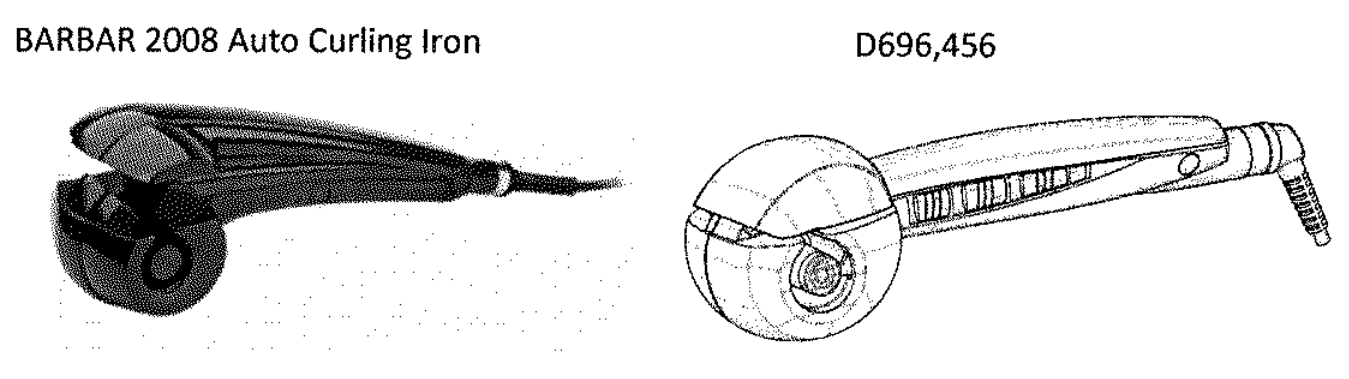
Conair Corp. v. Barbar, Inc. - Preliminary Injunctions in Design Patent Cases After eBay

A few weeks ago, we posted about a series of design patent cases filed by Conair Corp. against multiple defendants in the Middle District of Florida, relating to a design patent for a curling iron (see below for images).  On Thursday, Judge Gregory Presnell ruled on Conair's motion for a preliminary injunction in its case against Barbar, Inc. with some surprising results.  


In his July 3 order, Judge Presnell began his analysis by acknowledging the visible similarities between the Barbar curling iron and the curling iron depicted in the '456 Patent.  According to Judge Presnell, the product and design appeared "similar."  2014 WL 2993724, at * 1.  However, the Judge Presnell did not launch into a discussion of the likelihood of success on the merits, as one might expect in a preliminary injunction order.  Rather, he first discussed the likelihood of any irreparable harm, concluding that "the lack of a preliminary injunction will not cause irreparable injury to the Plaintiff," Conair.  

The key to Judge Presnell's reasoning is the wide disparity in the economic footprint of Conair versus that of Babar: 

While the products appeared similar, there was a striking difference in the volume of sales between the Plaintiffs' product and the Defendants' product. Specifically, the Plaintiffs estimated that the sales of their hair curling product resulted in over a million units sold in 2013 and more than two million units are projected to be sold in 2014. (Doc. 30 at 27:24–28:16). The Defendants' sales, however, were in the range of approximately 500 units, with a total production of only 2500 units. (See Id. at 106:25–107:6). Currently, the Defendants' total sales represent .025% of the Plaintiffs' projected sales this year. Even if the Defendants were to sell their entire inventory of 2500 units, that would represent only .125% of the Plaintiffs' projected sales for 2014.
Id.  

The court's reasoning closely tracked the Supreme Court's decision in eBay, Inc. v. MercExchange, L.L.C., 547 U.S. 388 (2006), where the Supreme Court held that the Federal Circuit erred by applying a categorical injunction where patent infringement was proved at trial.  See id. at 394 ("Just as the District Court erred in its categorical denial of injunctive relief, the Court of Appeals erred in its categorical grant of such relief.").  Judge Presnell found that eBay precludes the Federal Circuit's assumption that a preliminary injunction should normally issue if the plaintiff appears likely to prove design patent infringement on the merits.  Therefore, the Court opted to first analyze the likelihood of irreparable harm first, which the court found lacking, based on the relative sales volumes of the parties.  The court was unpersuaded by Conair's alleged injuries, finding that "assertions that the Defendants' product would be tarnished in a non-compensable manner are speculative."  Id. at *2.  

Conair Corp. v. Barbar, Inc. is noteworthy in design patent law for several reasons.  First, it will be exceedingly difficult for design patent holders to prove a likelihood of irreparable harm against smaller competitors who's sales are deemed "de minimis," as is often the case with a "knock-off" competitor.  Second, the Conair decision further shows that the standards for issuing an injunction in design patent cases is no different than in utility patent cases, despite the fact that design patent holders are entitled to a de facto injunction in the form of disgorged profits.  We commented on this issue previously with regard to the Apple v. Samsung case

The court's decision in the Barbar action likely dooms Conair's request for an injunction in its other cases in M.D. Fla. relating to the same design patent.  We will continue to monitor the "Conair cases" and update on any other interesting developments. 

Monday, May 19, 2014

Design Patent Links - May 19, 2014

It has been a while since our last design patent links post, so there's lots to share.  We begin with a design patent issue of first impression in the Eastern District of Arkansas and wrap up with a check-in on Apple v. Samsung:

Law360 has published an article about a fascinating design patent decision from the Eastern District of Arkansas.  In P.S. Prods. Inc. et al. v. Activision Blizzard Inc. et al., Case No. 4:13-cv-00342-KGB (E.D.Ark. filed June 5, 2013), P.S. Products sued Activision for infringing U.S. Design Patent No. 561,294 for a "Stun Gun," shown below.  The problem is that Activision is in the video game business, not the stun gun business.  P.S. Products was accusing Activision of infringement through its Call of Duty line of video games, which includes a video game stun gun that P.S. Prods claimed infringed its design patent.  On a motion to dismiss, the court found that the video game and the real-life stun gun were not “analogous article[s] of manufacture."  The Law360 article was authored by in-house counsel for Activision, Omer Salik and Neil Yang. 

In an interesting post on The Ordinary Observer (link), we recommended filing "virtual" design patents with any physical design, which may have avoided this very issue.
 
We usually try to stay away from the "interesting design patent" posts here at The Ordinary Observer, but this new Samsung design patent caught our eye for obvious reasons.  Can you tell which of the below designs belongs to Apple and which belongs to Samsung?  Both of these icon design have been granted by the USPTO:


ANSWER: The icon on the left is Samsung's U.S. Design Patent No.  704,217, which was granted back on May 6.  The icon on the right is Apple's U.S. Design Patent No. 671,558.  Several commentators have already picked up on the similarity between these two design patents, including MacRage, PatentlyApple, and Cult of Mac.  We have previously observed that the scope of design patents before the PTO appears to be far narrower than in a court of law, which is the opposite of what was intended.  However, this principle could be used as a shield in a design patent infringement suit.  Potential defendants may seek design patents of their own and, in effect, get an advisory opinion of non-infringement from the PTO in the form of a design patent listing the relevant prior art on its face.  In this sense, design patents, unlike utility patents, may be used as a shield as well as a sword.  Samsung appears to be applying this principle while it restarts settlement negotiations in their ongoing patent war with Apple, according to DailyTech.  

Finally, in addition to our own commentary, several others have posted on the first-ever successful Inter Partes Review process for Luv N' Care's sippy cup design patent, including Law360, Rstreet, National Law Review, and Virtual Press.  As noted by Digital Journal, Luv N' Care has issued a "clarification" of its pending lawsuit against Munchkin, stating its loss in the PTAB was based on a "technicality."  Apparently, Luv N' Care considers the Patent Act a technicality...


Tuesday, January 21, 2014

Design Patent Links - Jan.21, 2014


BlackBerry's design patent D685,775 covers the look of its keyboard, including the sculpted keys.Starting off this week's links with some good news in the patent world, a recent report shows that in 2012, worldwide patent applications saw their strongest growth in 18 years, with design patents ticking up by 17%, year over year.  This follows double-digit growth in design patent filings each year since 2010.  Of course, these numbers still lag behind the growth in utility patent filings over the same period.  Part of the recent surge is attributable to the increased participation of younger nations in the global marketplace; in 2012 for instance, Chinese residents led the world in new utility patent application filings for the first time.  Several questions remain.  How long can the market sustain double digit growth in new patent applications and what will governments, particularly the U.S. government, choose to do about it?  


Continuing on the international front, following the 24th U.S.-China Joint Commission on Commerce and Trade in December, China has further indicated that it will extend design patent protection to Graphical User Interfaces.  Readers of the Ordinary Observer may note that in we have reported on this subject before.  In October, the Chinese State Intellectual Property Office released a draft amended version of its Examination Guidelines, indicating for the first time that it was amenable to extending patent protection to GUIs and other so-called virtual designs. This is a significant step towards harmonizing U.S.-Chinese design patent law, as the United States has offered patent protection to so-called virtual designs for roughly twenty years.

In more consumer-driven news, several major technology companies are lighting up the technology blogs with design patent revelations.  First, Samsung and the U.S. PTO have joined forces to tease gadget journalists with newly issued design patents covering a foldable tablet, as well a new design rumored to be the next Galaxy series flagship phone.  On the enforcement side, struggling smartphone maker Blackberry has filed suit against Typo Products, LLC, the maker of a Bluetooth keyboard for smartphones which tends to evoke comparisons to Blackberry's iconic keyboard style.  The reactions from users and bloggers towards Blackberry's suit appear mixed, at best.   The lesson here appears to be that you can get press from both design patent suits and design patent grants, but the press for the former is very different than from the latter.

Finally, the Federal Circuit's recent decision in Pacific Coast Marine Windshields Limited v. Malibu Boats has succeeded in generating a fair amount of scholarship in its immediate aftermath.  See the following links for analysis of the decision, as well as The Ordinary Observer's own breakdown of the case

Wednesday, November 27, 2013

Design Patent Apportionment – “The Turducken Problem”

Everyone knows that the turkey makes Turducken look good, but it’s the duck that actually makes Turducken valuable … or is it the chicken? In any event, Turducken demonstrates a classic problem in design patent remedies – how do we disgorge “total profits” of the infringer when the profits are not necessarily attributable to the infringing design? For example, if I held a design patent on a Thanksgiving turkey, why should I be entitled to the total profits for the sale of a turducken if the infringer’s profits are, at least in part, attributable to the hidden duck and chicken? My turducken premise is running as thin as my mother-in-law’s gravy (sorry mom), but you get the point. 

This question of design patent law is more than a thanksgiving novelty. At the design patent conference at Suffolk Law School last Friday, Samsung’s attorney, Michael Geller, raised this issue in the context of the Apple v. Samsung case. From Samsung’s perspective, its accused Galaxy devices were profitable, at least in part, because of their functionality and software, not Apple’s patented designs which it was found to have infringed. 

There is some support in older design patent cases for the idea that disgorged profits should be apportioned between profits attributable to the infringing design and profits attributable to other, separable, aspects of the accused product. In Bush & Lane Piano Co. v. Becker Bros., 222 F. 902, 903-904 (2d Cir. 1915), the Second Circuit held that the infringer’s profits attributable to the infringing piano case was separable from the profits attributable to the internal mechanisms of the piano. See Bush at 903 (apportioning profits between “the structure which incloses and holds in position the piano proper, viz., the part which produces the music. The former appeals to the eye, the latter to the ear.”). According to the Second Circuit “[w]hen the patent owner is awarded the profits due to his design he receives all he is entitled to. If ... a design [patent] for a case enables the owner to collect damages for  ... the contents of the case as well, it will lead to results which shock the conscience. A design for a watch case will include the watch itself. A design for a gun case will include the gun, a design for a hat case will include the hat and so on.” Id. at 905.

The decision in Bush appears to contrast with the modern understanding of the disgorgement remedy, however. In Nike Inc. v. Wal-Mart Stores, 138 F.3d 1437, 1442 (Fed. Cir. 1998), the Federal Circuit stated that one of the key differences between the 1946 Act and the design patent statute, “as enacted in 1887, was the removal of the need to apportion the infringer's profits between the patented design and the article bearing the design.” Id. While this comment was not central to the court’s decision, Nike is viewed as a watershed decision on the nature and history of the disgorgement remedy for design patent infringement. 

Yet, Samsung’s position is not without hope.  Both the 1887 Act and the 1946 Act simply codified what had always been an equitable remedy for design patent infringement. This remedy was based on a theory of unjust enrichment or accounting which was never intended to be punitive. See SEC v. Blatt, 583 F.2d 1325, 1335 (5th Cir. 1978) (“Disgorgement is remedial and not punitive. The court's power to order disgorgement extends only to the amount with interest by which the defendant profited from his wrongdoing. Any further sum would constitute a penalty assessment.”); Restatement (Third) of Restitution and Unjust Enrichment § 51 cmt. e.4 (Tentative Draft No. 5, 2007) (“Disgorgement does not impose a general forfeiture: defendant's liability in restitution is not the whole of the gain from a tainted transaction, but the amount of the gain that is attributable to the underlying wrong.”). 

Perhaps the solution to the turducken problem lies in the equitable roots of the disgorgement remedy. It is said that "equity abhors a forfeiture,” and so perhaps courts should have enough equitable discretion, even under 35 U.S.C. § 289, to apportion an infringer’s profits in a manner that reflects the profits fairly attributable to the infringing design. 

Whichever way you slice it, the turducken problem will likely play a major role in any appeal from the damages award in  Apple v. Samsung. The parties have already briefed this issue before Judg Koh. I suspect that the Federal Circuit may use this as an opportunity to refine its comments about apportionment in the Nike case. 

Happy Thanksgiving everyone!

Monday, November 25, 2013

Design Patent Links – Nov. 25, 2013

It was a fairly slow week in design patent law. Aside from Suffolk Law School’s design patent conference, all eyes were on Apple v. Samsung and the Federal Circuit’s third decision in the ongoing worldwide litigation between the two technology giants. As for the design patent conference, I think it is safe to declare it a great success. Several guest speakers, including design patent giants Chris Carani, Perry Saidman, and Michael Zeller presented on everything from the “matter of concern doctrine” to the damages issues being raised in Apple v. Samsung. For full coverage see our live

blog of the A.M. session and the P.M. session.

In other news, the analysis of the Federal Circuit’s decision in Apple v. Samsung III continues to pop up across the Internet. Prof. Sarah Burstein’s piece on Patently-O is a good summary of the court’s decision and potential ramifications.

Law 360 had a short explanation of the facts relating to the latest design patented fashion fight in Hanesbrands v. Lululemon, which was filed last week. This should be another interesting design patent grudge match in the fashion world.

As always, if you have any design patent news you would like to see on the Ordinary Observer, please do not hesitate to contact me. Thanks!

Friday, November 22, 2013

Design Patents: Modernizing an Old Property Interest (P.M. Session Live Blog)

We are back from our lunchtime discussion that was directed by Gary Dewar, Senior IP Counsel of New Balance.  Mr. Dewar lead us on an interesting discussion of design patent practice from the client's perspective.  Most interesting was Mr. Dewar's observation that clients tend to view design patents as a gap filler, used when competitors or counterfeiters seek to copy the appearance of a product, but are incapable of replicating the functionality of the product.  Another helpful observation was that the strength of a design patent was almost secondary to the speed with which it can be awarded by the patent office.  Most of the "businesses" that design patent owners confront have no interest in contesting infringement or validity and will simply cease all operation upon receiving a cease and desist letter.  Practitioners should keep this in mind.

More from the P.M. session after the jump!

Design Patents: Modernizing an Old Property Interest (A.M. Session Live Blog)

In lieu of this week's Design Patent Roundup, we will be live blogging the discussion taking place at today's design patent conference at Suffolk University Law School.  We will be providing highlights through Facebook and Twitter, but you can find more details here on the blog.  People are just beginning to arrive for the conference, so the live blogging will commence soon.  Enjoy!

See all our notes after the jump. 


Wednesday, November 20, 2013

Apple v. Samsung – Part III: Shouldn’t a Different Set of Rules Apply to Design Patent Injunctions?

Apple v. Samsung is truly the design patent case that keeps on giving, and Monday’s Federal Circuit decision is no different. This time, Apple asked the Court to review Judge Koh’s decision denying Apple’s request for a permanent injunction against future infringement of Apple’s patents. In a unanimous decision, Judges Prost, Bryson, and O’Malley affirmed the district court’s decision with respect to Apple’s design patents, but vacated and remanded for further consideration with respect to Apple’s utility patents.

Essentially, the Federal Circuit found that there was no evidence of a “causal nexus” between Samsung’s infringement of Apple’s design patents and Apple’s established loss of market share to Samsung. See Apple v. Samsung III, at 12 (“If the patented feature does not drive the demand for the product, sales would be lost even if the offending feature were absent from the accused product. Thus, a likelihood of irreparable harm cannot be shown if sales would be lost regardless of the infringing conduct.”). According to the Court, Apple's loss of market share may have occurred because of several unrelated and perfectly legal reasons having nothing to do with Apple’s design patents. As such, the court reasoned that irreparable harm could not be shown as a result of future infringement by Samsung. According to the Federal Circuit, the causal nexus requirement “reflects general tort principles of causation.” Id. at 13 (emphasis added).

However, Apple v. Samsung III may be more noteworthy for what it failed to discuss. For example, it is unclear whether the “causal nexus” requirement makes sense in the context of design patents, where Apple already has an equitable remedy for disgorgement of Samsung’s illicit profits for any ongoing or future design patent infringement. In reality, Apple already has a de facto injunction against further infringement by Samsung because it would be entitled to recoup all of Samsung’s profits for any such design patent infringement, even without proving any actual harm or damage to Apple. Yet, the Federal Circuit never addressed this significant difference between utility and design patents in Apple III. Indeed, the disgorgement remedy for design patent infringement is an exception to the very “tort principles of causation” referenced by the court.

In the author’s opinion, the built-in equitable remedy for disgorgement of profits from design patent infringement should impact the permanent injunction analysis for design patents. The equitable remedy of disgorgement exists because Congress has determined that harm and causation should be presumed when a party infringes a design patent. This equitable principal of design patent law should inform the court’s analysis when considering a permanent injunction against further design patent infringement.

Apple does not appear to have argued that design patents should not be subject to a causal nexus requirement because of the unique disgorgement remedy for design patent infringement. However, the court made one statement that offered a glimpse into its possible position on this line of reasoning. Apple argued that the “causal nexus” requirement should only apply to a motion for a preliminary injunction so as not to vitiate a patent owner’s right to exclude others from practicing the patent. In response the Federal Circuit quoted the Supreme Court’s decision in eBay, reasoning that “the creation of a right is distinct from the provision of remedies for violations of that right.” Id. at 17 (eBay, Inc. v. MercExchange, L.L.C., 547 U.S. 388, 392 (2006)). However, this admonishment does not explain the failure to address the impact of the disgorgement remedy on the injunction analysis. Presumably, the creation of an equitable remedy, such as disgorgement, would be highly relevant to the application of another equitable remedy for the same violation, such as an injunction.

Just add this to the growing list of questions for Apple and Samsung’s attorneys during this week’s design patent conference at Suffolk University School of Law.

Monday, November 4, 2013

Design Patent Links - Nov. 4, 2013


We are less than three weeks away from the second major design patent conference of 2013! On Friday, November 22, Suffolk Law School will be hosting a design patent conference titled “Design Patents : Modernizing an Old Property Interest.” The conference promises to be an insightful follow-up to the design patent conference hosted by Stanford Law School back in April. You can see the full details for the event here. The topics that will be discussed during the conference include design patent scope, design patent litigation, design patent damages, and Hague Treaty rulemaking. The confirmed speakers and panelists thus far include Chris Carani , Perry Saidman, and David Gerk and Brian Hanlon, both from the U.S. P.T.O. Attorney Michael T. Zeller, who represented Samsung in the Apple v. Samsung case will also be participating.

This conference should be another great opportunity to discuss contemporary issues in design patent law and to hear from some of the preeminent experts in the design patent space. The Ordinary Observer is planning to attend and will provide detailed coverage. If you are interested in attending, please sign up here.

For those interested in discussing the conference on Twitter, the organizers are encouraging the public to use the hash tag #designpatentlaw.

In other design patent news, Fanny Siu and Alison Wong of Bird & Bird have penned an informative article on the ease of seeking design patent protection in China.

Tracy-Gene G. Durkin and David K.S. Cornwell of Sterne Kessler Goldstein & Fox have offered an informative summary of the Federal Circuit’s recent design patent decision in Spencer v. Taco Bell Corp. The decision provides further insights into the Federal Circuit’s thinking on the written description requirement for design patents in the wake of the decision in In re Daniels just a few short months ago.

Over at The Faculty Lounge, Sarah Burstein has posted an article about the double standards for utility patent prosecutors and design patent prosecutors. Did you know that design patent prosecutors can qualify for the position with an art degree?

As always, we will be on the lookout for more design patent news!