On December 6, 2016, the Supreme Court issued a unanimous opinion authored by Justice Sotomayor in the Samsung Electronics Co., Ltd. v. Apple, Inc. case concerning apportionment of design patent damages under 35 U.S.C. § 289. Specifically, § 289 makes it unlawful to produce or sell an “article of manufacture” bearing a patented design and makes infringers liable to the patent holder “to the extent of [their] total profit.” The Supreme Court’s ruling rejects Apple’s argument and holds that the meaning of the phrase “article of manufacture” can refer to a single component within a multicomponent product sold to consumers. In support of its reasoning, the Court cites a similarly broad interpretation of the phrase as previously applied to 35 U.S.C. § 171. The § 171 statute defines subject-matter eligibility for design patents.

Showing posts with label design patents. Show all posts
Showing posts with label design patents. Show all posts
Tuesday, December 6, 2016

Tuesday, May 3, 2016
Design Patent Destinations - Hague Seminar to be Presented by WIPO in Geneva
 If you're looking to travel and learn about international design patent application regimes, then look no further than WIPO's Hague Seminar, which is taking place on June 23 in Geneva, Switzerland. The stated objectives of the Seminar are to give practical guidance to users when designating the United States of America, Japan or the Republic of Korea in an international design application and to receive feedback from those Offices as Designated Contracting Parties. You can access WIPO's brochure for the seminar here.
 WIPO's Hague Convention seminar comes at an important point in the United States' adoption of the Hague Convention. While the Hague Convention filing process has been available in the United States since May of 2015, surprisingly few applicants have applied for an International Design Patent through the United States Patent Office, as we learned this year at Design Day. While the Hague Convention certainly presents a more streamlined and cost-effective approach to international design registration, uncertainty regarding regional differences in design practice may be slowing the adoption of the system here in the United States. Hopefully, the WIPO seminar in June can help provide a clearer path for U.S. filers.
Monday, April 18, 2016
USPTO Requests Comments on Proposed Written Description Guidance for Design Patents
The United States Patent and Trademark Office has issued a Request for Comments on its proposed guidance to patent examiners regarding the written description requirement in Section 112 of the Patent Act with respect to design patents. The proposed guidance would address situations where an amended or continuing application claims only a subset of the elements disclosed in an earlier or original application. In other words, in the example below, if the original claim comprised the images on the left, can the amended claim cover only the subset of elements shown in solid lines on the right?


Thursday, February 5, 2015
Looking at Inter Partes Review for Design Patents
It has been nearly one year since the Patent Trial and
Appeals Board first invalidated a design patent in inter partes review. Munchkin,
Inc. v. Luv N' Care, Ltd. decision, No. IPR2013-00072 (P.T.A.B. Apr. 21,
2014). The Ordinary Observer reported on that decision last April. The time seems right to check in on the PTAB to see how design patents have fared since that decision
made waves in the patent community.
Despite the impact made by the PTAB in Munchkin, IPR remains a rarely used tool for defendants in design patent
litigation. In addition to Munchkin, we have found 7 petitions for
review on 7 design patents from 3 petitioners since the practice began in
September 2012. To date, only Munchkin has reached a final decision on
the merits. While this subset is still
limited, it may give us some insight into how the Board is interpreting these
petitions, and where the practice may be headed.
We begin by looking at the petitions filed by each of
the three petitioners.
Thursday, September 11, 2014
Doorman v. Paccar - For Design Patents, Inter Partes Review is Non-Functional
Sometimes lawyers learn more from their failures than their successes, and this has proven to be true in the context of inter partes review of design patents. Since the Patent Trial and Appeal Board launched the IPR program in 2012, there have been only a handful of design patent decisions, but with each new decision, we learn a bit more about how the PTAB will approach design patents.
Last Friday, the PTAB handed down a decision in Doorman Prods., Inc. v. Paccar, Inc., IPR2014-00542, 2014 WL 4444041 (Patent Tr. & App. Bd. Sept. 5, 2014). In its decision, the Board denied Doorman's Petition to institute an inter partes review, but it is the Board's reasoning that was noteworthy. Below is an image from Paccar's U.S. Patent No. 525,731, which was the subject of the petition.

First, the Board categorically rejected Doorman's request to filter out functional elements within the design in the context of claim construction. The Board curiously found that the "Petitioner conflates invalidity based on functionality under 35 U.S.C. § 171 with invalidity based on obviousness under 35 U.S.C. § 103" and held that the it had no authority to entertain a functionality challenge to the design patent:
Further, a challenge based on functionality under 35 U.S.C. § 171 is not permitted in an inter partes review because it is not based on 35 U.S.C. § 103 nor is it based on prior art that consists of a patent or printed publication. 35 U.S.C. § 311(b); 37 C.F.R. § 42.105(b)(2). Therefore, we agree with Patent Owner that the allegedly functional elements identified by Petitioner (Pet. 12) must be considered in an obviousness analysis of the visual impression created by the patented design as a whole (Prelim. Resp. 26).Id. at *3.
The Board appears to have badly misconstrued the Petitioner's claim construction argument with an invalidity challenge under § 171. The Board's decision to construe the Petitioner's claim construction argument as a validity argument seems to be out of step with the Board's requirement to apply the "broadest reasonable construction." Furthermore, it directly contradicts the Federal Circuit's guidance on design patent claim construction. See OddzOn Prods., Inc. v. Just Toys, Inc., 122 F.3d 1396, 1405 (Fed. Cir. 1997) (if "a design contains both functional and non-functional elements, the scope of the claim must be construed in order to identify the non-functional aspects of the design."). Whatever the "broadest reasonable construction" means in design patent cases before the PTAB, it must at least be as broad as the construction that would be provided in the context of a district court litigation.
The Patent Office's failure to appreciate how design patents are being construed in the district courts has led to a strange double standard wherein design patents are construed much more narrowly at the Patent Office then they are in litigation. IPR may be an interesting venue for bringing this issue to a head and encouraging the Patent Office and the Board to consider modernizing its view of the broadest reasonable construction for designs, in light of how they are being construed, in practice.
In Doorman, the Board's failure to consider functionality in the context of claim construction led to disastrous results for the Petitioner. The Board ultimately concluded that the Petitioner's primary reference, Kobayashi, "does not include a side Lamp D, striations, and a checkered surface pattern as shown in the patented design," id. at *5, and therefore could not serve as a primary reference. But these were the same features that Doorman argued were functional in claim construction. Whatever the merits of the Petitioner's functionality argument were, they appeared to be central to its Petition, and the Board's refusal to even consider filtering out functional elements would appear to be a clear error of law.
Nevertheless, while Doorman remains the law of the PTAB, design patent practitioners would be wise not to rely on PTAB claim construction to filter out functional elements of design patent in IPR Petitions.
For those who are curious, below is an image of Paccar's '731 Patent alongside the proposed primary reference, U.S. Design Patent No. 498,859 to Kobayashi. Basically the same?

Wednesday, August 27, 2014
Pacific Coast v. Malibu Boats - The Nightmare Apportionment Scenario Realized
Last Friday we commented on Professor Lemley's amicus brief in the Apple v. Samsung case, which addresses the issue of apportionment in design patent law. Apparently, Judge John Antoon II of the Middle District of Florida was working on his own "post" on design patent apportionment at the same time. Last Friday, Judge Antoon issued a decision denying Malibu's motions for summary judgment, including a motion to limit potential damages to the profits for the accused windshields in the case of Pacific Coast Marine Windshields, Ltd. v. Malibu Boats, LLC. As a result of Judge Antoon's decision Malibu's total profits for the sale of its speedboats will be at risk if they are found to have infringed Pacific Coast's design patent on a boat windshield.
Here's a graphic to help explain the decision:

You might recall this case from its previous trip to the Federal Circuit, where the court reversed Judge Antoon's decision to apply prosecution history estoppel to limit Pacific Coast's claims against Malibu. While the Federal Circuit held that prosecution history estoppel applies to design patent, the court reversed the district court’s summary judgment of non-infringement because it found that the accused design was not within the scope of the subject matter surrendered during prosecution.


It is unclear why Malibu Boats did not renew its motion for summary judgment on remand. Although its prosecution history estoppel argument had been defeated, it still had strong non-infringement arguments as a result of the Federal Circuit's decision. For example, if, as the Federal Circuit says, the accused windshield was not within the scope of the canceled figure, then how could the accused windshield be within the scope of the remaining figures of the '070 Patent? The accused design appears to be more similar to the cancelled figure than the asserted design, and that fact might have been enough for Judge Antoon to grant summary judgment.
Malibu's decision not to renew its motion for summary judgment on non-infringement may cost them. Judge Antoon's decision on Friday was a simple matter of statutory interpretation. The court found that its hands were tied in light of the statutory history of § 289:
Congress removed the apportionment requirement in
1887, with the enactment of what later became§ 289. [See Nike.
Inc. v. Wal-Mart Stores. Inc., 138 F.3d 1437, 1441 (Fed. Cir. 1998)]. Design
patent owners are no longer required “to apportion the infringer's profits
between the patented design and the article bearing the design.” Id. at 1442. The intent of Congress to allow more expansive
recovery for design patent owners is exhibited in the plain language of the
statute, which allows recovery of "total profit" from anyone who
sells “any article of manufacture to which such design or colorable imitation
has been applied.” 35 U.S.C. § 289. In
this case, Malibu sells boats, to which patented windshields have been applied.
The plain language and intent of the statute support a conclusion that Pacific
is entitled to Malibu's profits from the sale of its boats with the windshield.
This reading of § 289 is further supported by Federal
Circuit and district court decisions. In Nike,
the Federal Circuit referred to the damages as profits from "the infringing
shoes" when the patent involved only part of the shoe. 138 F .3d at 144 7.
In Apple. Inc. v. Samsung Electronics Co.,
the plaintiff had several patents pertaining to smartphones and tablet
computers that claimed a portion of the design of particular electronic devices
but disclaimed other portions. 678 F.3d 1314, 1317 (Fed. Cir. 2012). With
respect to damages based on the defendant's profits, the district court ruled
that the plaintiff was not required to prove which portions of the profits were
earned by the design feature. Apple. Inc. v. Samsung Elecs. Co., 926 F. Supp.
2d 1100, 1111 (N.D. Cal. 2013). "Congress specifically drafted the design
patent remedy provisions to remove an apportionment requirement that the
Supreme Court had imposed. Thus, there is simply no apportionment requirement
for infringer's profits in design patent infringement under § 289." Id.
While Judge Antoon's legal analysis is correct, the case of Pacific Coast v. Malibu Boats is a striking example of the sometimes inequitable result of § 289 in the absence of any equitable discretion in the hands of the Court. Malibu's boats sell for anywhere between $50,000 and nearly $100,000, while the accused windshields cannot possibly cost more than a few hundred dollars, standing alone. This is precisely the type of inequitable scenario that Professor Lemley highlighted in his amicus brief and is the type of situation that the Federal Circuit must grapple with in the appeal from the Apple v. Samsung case.
Monday, July 7, 2014
Conair Corp. v. Barbar, Inc. - Preliminary Injunctions in Design Patent Cases After eBay
A few weeks ago, we posted about a series of design patent cases filed by Conair Corp. against multiple defendants in the Middle District of Florida, relating to a design patent for a curling iron (see below for images). On Thursday, Judge Gregory Presnell ruled on Conair's motion for a preliminary injunction in its case against Barbar, Inc. with some surprising results.
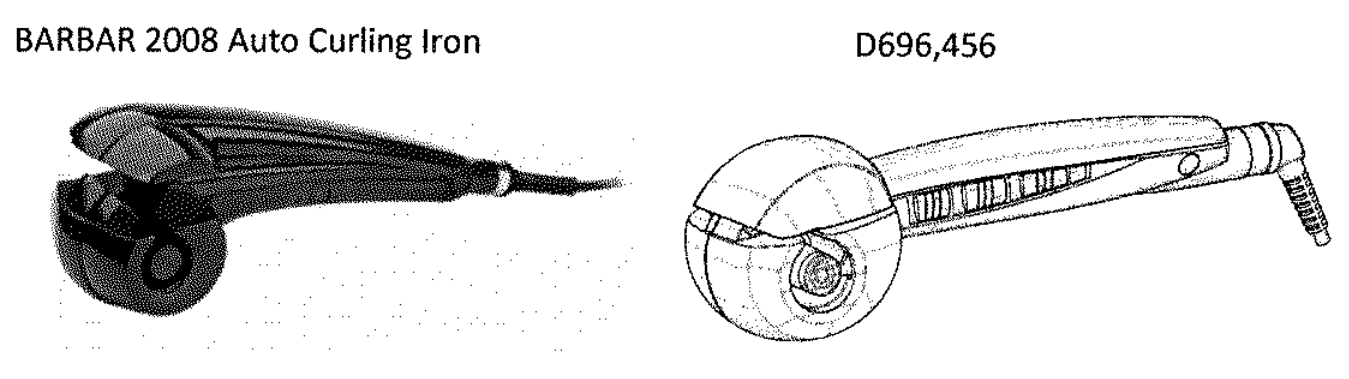
In his July 3 order, Judge Presnell began his analysis by acknowledging the visible similarities between the Barbar curling iron and the curling iron depicted in the '456 Patent. According to Judge Presnell, the product and design appeared "similar." 2014 WL 2993724, at * 1. However, the Judge Presnell did not launch into a discussion of the likelihood of success on the merits, as one might expect in a preliminary injunction order. Rather, he first discussed the likelihood of any irreparable harm, concluding that "the lack of a preliminary injunction will not cause irreparable injury to the Plaintiff," Conair.
The key to Judge Presnell's reasoning is the wide disparity in the economic footprint of Conair versus that of Babar:
While the products appeared similar,
there was a striking difference in the volume of sales between the Plaintiffs'
product and the Defendants' product. Specifically, the Plaintiffs estimated
that the sales of their hair curling product resulted in over a million units
sold in 2013 and more than two million units are projected to be sold in 2014.
(Doc. 30 at 27:24–28:16). The Defendants' sales, however, were in the range of
approximately 500 units, with a total production of only 2500 units. (See Id. at
106:25–107:6). Currently, the Defendants' total sales represent .025% of the
Plaintiffs' projected sales this year. Even if the Defendants were to sell
their entire inventory of 2500 units, that would represent only .125% of the
Plaintiffs' projected sales for 2014.
Id.
The court's reasoning closely tracked the Supreme Court's decision in eBay, Inc. v. MercExchange, L.L.C., 547 U.S. 388 (2006), where the Supreme Court held that the Federal Circuit erred by applying a categorical injunction where patent infringement was proved at trial. See id. at 394 ("Just as the District Court erred in its categorical denial of injunctive relief, the Court of Appeals erred in its categorical grant of such relief."). Judge Presnell found that eBay precludes the Federal Circuit's assumption that a preliminary injunction should normally issue if the plaintiff appears likely to prove design patent infringement on the merits. Therefore, the Court opted to first analyze the likelihood of irreparable harm first, which the court found lacking, based on the relative sales volumes of the parties. The court was unpersuaded by Conair's alleged injuries, finding that "assertions that the Defendants' product would be tarnished in a non-compensable manner are speculative." Id. at *2.
Conair Corp. v. Barbar, Inc. is noteworthy in design patent law for several reasons. First, it will be exceedingly difficult for design patent holders to prove a likelihood of irreparable harm against smaller competitors who's sales are deemed "de minimis," as is often the case with a "knock-off" competitor. Second, the Conair decision further shows that the standards for issuing an injunction in design patent cases is no different than in utility patent cases, despite the fact that design patent holders are entitled to a de facto injunction in the form of disgorged profits. We commented on this issue previously with regard to the Apple v. Samsung case.
The court's decision in the Barbar action likely dooms Conair's request for an injunction in its other cases in M.D. Fla. relating to the same design patent. We will continue to monitor the "Conair cases" and update on any other interesting developments.
Friday, May 30, 2014
Design Patents Cover Designs, Not Concepts... Usually
There was only one design patent case filed this week, so I've decided to focus this post on a reoccurring issue in design patent law instead of our usual Friday roundup of new design patent cases. As I noted in last week's roundup, there have been several recent design patent cases representing a recurring theme - plaintiffs who incorrectly believe that their design patent covers a concept as opposed to a design. This misconception is the cause of many dubious design patent infringement claims, and is only exacerbated when counsel fail to properly explain the purpose of a design patent, both during prosecution and prior to commencing litigation.
Last week's design "concept" case was Chuck Roaste, LLC v. Reverse Gear, LLC et al, No. 1-14-cv-01109 (N.D. Oh. May 22, 2014). This lawsuit deals with a design concept for reversed trousers, having pockets on both the front and the back of the garment so that it may be worn either forwards or backwards. The problem with the Chuck Roaste lawsuit, in this author's opinion, is that the examples of alleged infringement in the complaint tends to demonstrate non-infringement in the eye of the ordinary observer. This suggests that the lawsuit has less to do with Chuck Roaste's design patents and more to do with the plaintiff's belief that the design patent-in-suit covers the concept of reversible pants, which it cannot. For example, one of the figures of the '055 Patent, as shown in the Complaint, claims a leopard print pattern on both the belts and the pockets, which do not appear on the accused Reverse Gear jeans. In my experience people rarely confuse leopard print with plain old denim...

This week's sole design patent case presents a similar design "concept" litigation. On Wednesday, one Victoria Burnett filed the case of Burnett v. Bevacqua-Brewer et al, No. 1-14-cv-01706 (D. Md. May 28, 2014). This is essentially a lawsuit between two individuals that make pet beds out of vintage, used luggage. The design patent-in-suit is U.S. Patent No. 677,840, titled "Suitcase Pet Bed." Again, the problem with this case is one of design patent scope. As shown below, the '840 Patent covers a particular pet bed, not the concept of making a bed for an animal out of an old suitcase. Nor does the '840 Patent include any alternative embodiments. For some reason. Ms. Burnett elected to claim her design concept using only a generic rectangular suitcase, with a generic handle, and generic locks, as shown below:

However, the pet beds made by the named defendant, Anna Bevacqua-Brewer, are not limited to such mundane designs. As shown on her website, she applies this concept to a vast array of vintage suitcases, each having a design that is noticeably different from the suitcase claimed as part of the '840 Patent. Indeed, I was unable to find any suitcases on Ms. Bevacqua's website that used a suitcase similar to the one claimed as part of the '840 Patent. Ms. Burnett's decision to claim a particular vintage suitcase in her design patent would likely doom her case to failure, but for the cost of defending even a frivolous case of design patent infringement (Octane Fitness aside).

Design patent scope has always been a tricky issue, but there are some guiding principles that can help steer courts and would-be plaintiffs down the right path. Design patent guru, Perry Saidman is fond of reminding practitioners that design patent scope has almost as much to do with the prior art as it has to do with the dashed and solid lines within the figures. A proper infringement assessment cannot be made without looking at both asserted design, the accused product, and the prior art. See, e.g., Saidman, Perry, Egyptian Goddess Exposed! But Not in the Buff(er)..., 90 J. Pat. & Trademark Off. Soc'y 859, 877 (2008) (discussing the prior art implications of Smith v. Whitman Saddle Co., 148 U.S. 674 (1893)). In general, the more crowded the field of prior art is, the more narrowly a design patent should (or would) be interpreted by an ordinary observer. Conversely, if a design patent is a true "pioneer" design patent, one might expect its scope to be somewhat broader in the eye of the ordinary observer.
Yet, even a pioneer design patent cannot overcome clear claim limitations based on solid lines, and a design patent can only be expanded so far in the ordinary observer's mind by the state of the prior art. In this author's opinion, even a total dearth of relevant prior art should not permit a design patent to preclude all further applications of a design concept, like "making pet beds out of suitcases." To do so would improperly convert a design patent into some kind of bizarre aesthetic utility patent. Design patents are meant to cover designs, not design concepts... usually.
Wednesday, January 22, 2014
Pacific Coast after the Federal Circuit - Windshield Vents in the Eye of the Ordinary Observer
Last week, The Ordinary Observer reported on the Federal Circuit's recent decision in Pacific Coast Marine Windshields Ltd. v. Malibu Boats, holding for the first time that prosecution history estoppel applies to design patents, while finding in the case at bar that the patentee was not estopped from asserting its patent against the accused infringer. We have noted since then that legal observers have followed this decision, and Pacific Coast has already issued a press release calling it a big win. At this stage, it might be important to remind readers that this case may still have some legs left, and Pacific Coast may not want to open the champagne just yet.
Wednesday, October 16, 2013
Is There a “Design of Nature” Exception for Design Patents?
Authors comment: Contrary to the rumors you might have heard, the Ordinary Observer Blog is still alive and well. It turns out that litigating in a rocket docket is not conducive to consistent blogging, but with that out of the way, we will now return to our standard blogging regimen…
One of the most interesting aspects of design patent law is the fact that old cases really matter. One obvious example is Gorham v. White, which the Supreme Court decided in 1872 and which is still cited in almost every design patent decision. But even less routine questions of design patent law are often answered in decisions that are 20, 40, or even 80 years old. For example, a question that often comes up in design patent litigation and prosecution is the issue of designs that are inspired by nature, such as shapes and designs that are modeled after animals or naturally occurring objects. As is so often the case with design patents, the leading authority comes from old cases: two 1935 decisions of the Court of Customs and Patent Appeals both called In re Smith, 77 F. 2d 513 (Smith I) and 77 F. 2d 514 (Smith II).
In both of the Smith cases, the CCPA was asked whether the PTO had properly rejected applications for a design patent on a doll as not constituting design-patentable subject matter. The court described one doll design as follows:
the figure of a naked baby standing, holding its nursing bottle in its right hand, and applying a watch to its ear with its left hand. The appearance of the child is that of intense listening to the sound of the watch. The figure of the infant seems to be that of one about one year of age, and, so far as can be detected, is a representation of a normal child of that age, with no unusual features not found in the ordinary child.
Smith I. However, despite this seemingly unique scene, the CCPA upheld the PTO’s rejection of the designs as unpatentable because “what the appellant has done is to take a natural form, in a natural pose, and utilize it as his design. This does not constitute invention.” Id. Although the applicant pointed to several issued design patents for dolls, the Court held that those designs were distinguishable because each “had unusual, striking features, departing from the ordinary, and which were alluded to in the cited cases, such as the exaggerated headdress, elongated eyelashes, and the spit curls in the ‘Splashme’ doll. Here there are no such abnormal or grotesque features.” Id. Below are the patentable doll designs discussed in the case:
One of the most interesting aspects of design patent law is the fact that old cases really matter. One obvious example is Gorham v. White, which the Supreme Court decided in 1872 and which is still cited in almost every design patent decision. But even less routine questions of design patent law are often answered in decisions that are 20, 40, or even 80 years old. For example, a question that often comes up in design patent litigation and prosecution is the issue of designs that are inspired by nature, such as shapes and designs that are modeled after animals or naturally occurring objects. As is so often the case with design patents, the leading authority comes from old cases: two 1935 decisions of the Court of Customs and Patent Appeals both called In re Smith, 77 F. 2d 513 (Smith I) and 77 F. 2d 514 (Smith II).
In both of the Smith cases, the CCPA was asked whether the PTO had properly rejected applications for a design patent on a doll as not constituting design-patentable subject matter. The court described one doll design as follows:
the figure of a naked baby standing, holding its nursing bottle in its right hand, and applying a watch to its ear with its left hand. The appearance of the child is that of intense listening to the sound of the watch. The figure of the infant seems to be that of one about one year of age, and, so far as can be detected, is a representation of a normal child of that age, with no unusual features not found in the ordinary child.
Smith I. However, despite this seemingly unique scene, the CCPA upheld the PTO’s rejection of the designs as unpatentable because “what the appellant has done is to take a natural form, in a natural pose, and utilize it as his design. This does not constitute invention.” Id. Although the applicant pointed to several issued design patents for dolls, the Court held that those designs were distinguishable because each “had unusual, striking features, departing from the ordinary, and which were alluded to in the cited cases, such as the exaggerated headdress, elongated eyelashes, and the spit curls in the ‘Splashme’ doll. Here there are no such abnormal or grotesque features.” Id. Below are the patentable doll designs discussed in the case:

The CCPA explained its reasoning in Smith II, stating that "mere simulation or imitation of natural forms, which any artisan has the right to apply to any object, is not properly the subject of a patent." Smith II. “The difference between what constitutes invention and a mere imitation of natural forms suggests itself in the gargoyles of architecture and the unicorn and dragons of English and French heraldry. These abnormal forms might well constitute invention and be the subject of design patents, while mere imitation of reproductions of a normal horse or serpent or human face might not. It is the departure from the normal and usual which, in such cases, might constitute invention.” Smith I.
The Smith cases are still good law. Yet, in the years since they were decided, this obscure rule of design patent law seems to have received little attention, and one can find many examples of seemingly natural designs finding their way through the PTO, apparently without embellished or grotesque features:
The Smith cases are still good law. Yet, in the years since they were decided, this obscure rule of design patent law seems to have received little attention, and one can find many examples of seemingly natural designs finding their way through the PTO, apparently without embellished or grotesque features:

However, with the renewed interest in utility patent eligibility under § 101, you may begin to see creative design patent defendants seek to reestablish this defense to design patent infringement. Designers should also seek to embellish their designs whenever possible, to ensure that their validity cannot be called into question for lack of design patent-eligible subject matter.
Subscribe to:
Posts
(
Atom
)