Monday, July 7, 2014

Conair Corp. v. Barbar, Inc. - Preliminary Injunctions in Design Patent Cases After eBay

A few weeks ago, we posted about a series of design patent cases filed by Conair Corp. against multiple defendants in the Middle District of Florida, relating to a design patent for a curling iron (see below for images).  On Thursday, Judge Gregory Presnell ruled on Conair's motion for a preliminary injunction in its case against Barbar, Inc. with some surprising results.  
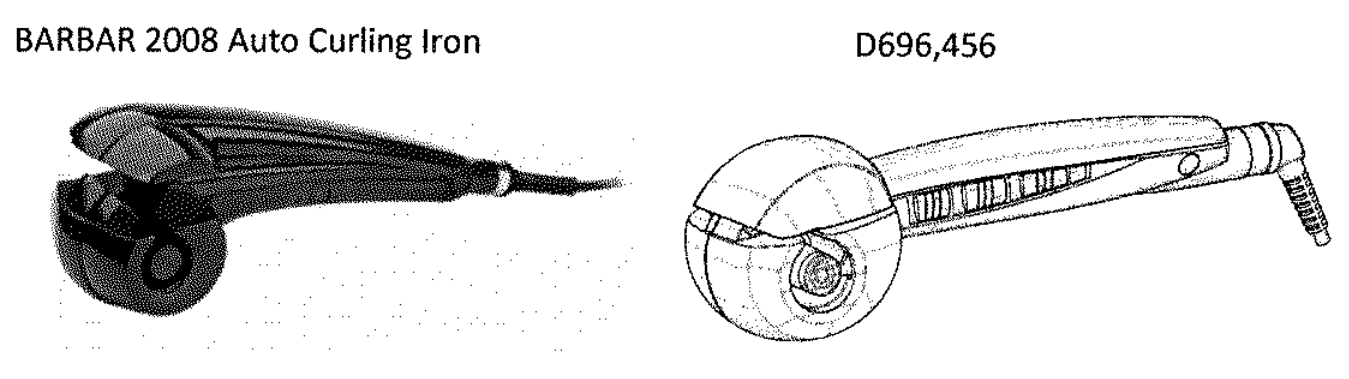

In his July 3 order, Judge Presnell began his analysis by acknowledging the visible similarities between the Barbar curling iron and the curling iron depicted in the '456 Patent.  According to Judge Presnell, the product and design appeared "similar."  2014 WL 2993724, at * 1.  However, the Judge Presnell did not launch into a discussion of the likelihood of success on the merits, as one might expect in a preliminary injunction order.  Rather, he first discussed the likelihood of any irreparable harm, concluding that "the lack of a preliminary injunction will not cause irreparable injury to the Plaintiff," Conair.  

The key to Judge Presnell's reasoning is the wide disparity in the economic footprint of Conair versus that of Babar: 

While the products appeared similar, there was a striking difference in the volume of sales between the Plaintiffs' product and the Defendants' product. Specifically, the Plaintiffs estimated that the sales of their hair curling product resulted in over a million units sold in 2013 and more than two million units are projected to be sold in 2014. (Doc. 30 at 27:24–28:16). The Defendants' sales, however, were in the range of approximately 500 units, with a total production of only 2500 units. (See Id. at 106:25–107:6). Currently, the Defendants' total sales represent .025% of the Plaintiffs' projected sales this year. Even if the Defendants were to sell their entire inventory of 2500 units, that would represent only .125% of the Plaintiffs' projected sales for 2014.
Id.  

The court's reasoning closely tracked the Supreme Court's decision in eBay, Inc. v. MercExchange, L.L.C., 547 U.S. 388 (2006), where the Supreme Court held that the Federal Circuit erred by applying a categorical injunction where patent infringement was proved at trial.  See id. at 394 ("Just as the District Court erred in its categorical denial of injunctive relief, the Court of Appeals erred in its categorical grant of such relief.").  Judge Presnell found that eBay precludes the Federal Circuit's assumption that a preliminary injunction should normally issue if the plaintiff appears likely to prove design patent infringement on the merits.  Therefore, the Court opted to first analyze the likelihood of irreparable harm first, which the court found lacking, based on the relative sales volumes of the parties.  The court was unpersuaded by Conair's alleged injuries, finding that "assertions that the Defendants' product would be tarnished in a non-compensable manner are speculative."  Id. at *2.  

Conair Corp. v. Barbar, Inc. is noteworthy in design patent law for several reasons.  First, it will be exceedingly difficult for design patent holders to prove a likelihood of irreparable harm against smaller competitors who's sales are deemed "de minimis," as is often the case with a "knock-off" competitor.  Second, the Conair decision further shows that the standards for issuing an injunction in design patent cases is no different than in utility patent cases, despite the fact that design patent holders are entitled to a de facto injunction in the form of disgorged profits.  We commented on this issue previously with regard to the Apple v. Samsung case

The court's decision in the Barbar action likely dooms Conair's request for an injunction in its other cases in M.D. Fla. relating to the same design patent.  We will continue to monitor the "Conair cases" and update on any other interesting developments. 

Friday, June 20, 2014

Design Patent Roundup - June 20, 2014

Design patent litigation appears to have picked up in the last week, with four new cases featuring interesting flip flop design.

Chad Habeeb v. Jukes Shoes, LLC, No. 1:14-cv-04649 (N.D. Ill. June 19, 2014)


On Thursday, Jukes Shoes, which appears to be a Dallas-are shoe retailer, was sued in the Northern District of Illinois for design patent infringement by one Chad Habeeb.  Jukes is accused of infringing Habeeb's U.S. Design Patent No. 687,216 for a "Pair of Sandals."  Below is a figure from the '216 Patent alongside an image of the accused sandals. 


Hutzler Mfg. Co., Inc. v. Christmas Tree Shops, Inc., No. 1:14-cv-04297 (S.D. N.Y. June 13, 2014)


Last Friday, Hutzler filed suit against Christmas Tree Shops in the Southern District of New York for allegedly infringing several of its design patents relating to vegetable containers.  The design patents-in-suit include U.S. Design Patent Nos. 538,114 ("Onion Container"); 553,443 ("Container"); 562,082 ("Tomato Keeper"); and 592,463 ("Garlic Container").  Below is a figure from the '114 Patent alongside an image of the accused container in the Complaint.  This case calls to mind a previous post about whether there is a "design of nature" exception to design patent protection.  Hertzler is represented by Curtis Mallet-Provost Colt & Mosle.  


Tucci, LLC v. Fiberbuilt Umbrellas, Inc., No. 1:14-cv-22185 (S.D. Fla. Jun 13, 2014)


On Friday the 13th, Tucci filed this lawsuit against Fiberbuilt in the Southern District of Florida, relating to certain umbrella designs.  Tucci is asserting both a utility patent - U.S. Patent No. 7,293,573 - and a design patent - U.S. Design Patent No. 478,416 for an "Umbrella Canopy."  Below is a figure from the '416 Patent alongside an image of the accused umbrella from the Complaint.  Tucci is being represented by the firm of Carey Rodriguez O'Keefe Milian Gonya.   The case has been assigned to Judge Joan A. Lenard. 


Conair Corp. v. Pro Curl Am. LLC, No. 6:14-cv-00919 (M.D. Fla. June 13, 2014), and 
Conair Corp. v. Argan Woman, No. 6:14-cv-00920 (M.D. Fla. June 13, 2014)


Last Friday, Conair filed a pair of lawsuits in the Middle District of Florida concerning a nifty design for a "Hair Styling Apparatus."  Both lawsuits assert three utility patents and Conair's U.S. Design Patent No. 696,456 for a "Hair Styling Apparatus."  A figure from the '456 Patent is shown below alongside the accused devices.  Conair is represented by Flachsbart & Greenspoon.  The case has been assigned to Judge Roy B. Dalton, Jr. 


Friday, May 30, 2014

Design Patents Cover Designs, Not Concepts... Usually

There was only one design patent case filed this week, so I've decided to focus this post on a reoccurring issue in design patent law instead of our usual Friday roundup of new design patent cases.  As I noted in last week's roundup, there have been several recent design patent cases  representing a recurring theme - plaintiffs who incorrectly believe that their design patent covers a concept as opposed to a design.  This misconception is the cause of many dubious design patent infringement claims, and is only exacerbated when counsel fail to properly explain the purpose of a design patent, both during prosecution and prior to commencing litigation.  

Last week's design "concept" case was Chuck Roaste, LLC v. Reverse Gear, LLC et al, No. 1-14-cv-01109 (N.D. Oh. May 22, 2014).  This lawsuit deals with a design concept for reversed trousers, having pockets on both the front and the back of the garment so that it may be worn either forwards or backwards.  The problem with the Chuck Roaste lawsuit, in this author's opinion, is that the examples of alleged infringement in the complaint tends to demonstrate non-infringement in the eye of the ordinary observer.  This suggests that the lawsuit has less to do with Chuck Roaste's design patents and more to do with the plaintiff's belief that the design patent-in-suit covers the concept of reversible pants, which it cannot.  For example, one of the figures of the '055 Patent, as shown in the Complaint, claims a leopard print pattern on both the belts and the pockets, which do not appear on the accused Reverse Gear jeans.  In my experience people rarely confuse leopard print with plain old denim...

  
This week's sole design patent case presents a similar design "concept" litigation.  On Wednesday, one Victoria Burnett filed the case of Burnett v. Bevacqua-Brewer et al, No. 1-14-cv-01706 (D. Md. May 28, 2014).  This is essentially a lawsuit between two individuals that make pet beds out of vintage, used luggage.  The design patent-in-suit is U.S. Patent No. 677,840, titled "Suitcase Pet Bed."  Again, the problem with this case is one of design patent scope.  As shown below, the '840 Patent covers a particular pet bed, not the concept of making a bed for an animal out of an old suitcase. Nor does the '840 Patent include any alternative embodiments.  For some reason. Ms. Burnett elected to claim her design concept using only a generic rectangular suitcase, with a generic handle, and generic locks, as shown below:  


However, the pet beds made by the named defendant, Anna Bevacqua-Brewer, are not limited to such mundane designs.  As shown on her website, she applies this concept to a vast array of vintage suitcases, each having a  design that is noticeably different from the suitcase claimed as part of the '840 Patent.  Indeed, I was unable to find any suitcases on Ms. Bevacqua's website that used a suitcase similar to the one claimed as part of the '840 Patent.  Ms. Burnett's decision to claim a particular vintage suitcase in her design patent would likely doom her case to failure, but for the cost of defending even a frivolous case of design patent infringement (Octane Fitness aside). 


Design patent scope has always been a tricky issue, but there are some guiding principles that can help steer courts and would-be plaintiffs down the right path.  Design patent guru, Perry Saidman is fond of reminding practitioners that design patent scope has almost as much to do with the prior art as it has to do with the dashed and solid lines within the figures.  A proper infringement assessment cannot be made without looking at both asserted design, the accused product, and the prior art.  See, e.g., Saidman, Perry, Egyptian Goddess Exposed! But Not in the Buff(er)..., 90 J. Pat. & Trademark Off. Soc'y 859, 877 (2008) (discussing the prior art implications of Smith v. Whitman Saddle Co., 148 U.S. 674 (1893)).  In general, the more crowded the field of prior art is, the more narrowly a design patent should (or would) be interpreted by an ordinary observer.  Conversely, if a design patent is a true "pioneer" design patent, one might expect its scope to be somewhat broader in the eye of the ordinary observer.

Yet, even a pioneer design patent cannot overcome clear claim limitations based on solid lines, and a design patent can only be expanded so far in the ordinary observer's mind by the state of the prior art.  In this author's opinion, even a total dearth of relevant prior art should not permit a design patent to preclude all further applications of a design concept, like "making pet beds out of suitcases."  To do so would improperly convert a design patent into some kind of bizarre aesthetic utility patent.  Design patents are meant to cover designs, not design concepts... usually.  

Friday, May 23, 2014

Design Patent Roundup - May 23, 2014

This week's design patent roundup brings us five new cases, including a design patent for the "Kris Kross" concept, a balloon design patent with 576 figures representing 35 embodiments, and a plaintiff with no future as a photographer.  Basically, aside from Gillette's razor blade case, it has been a strange week.  

One point worth noting is that four out of five of this week's cases were filed in Ohio, which is quietly become a hotbed of design patent litigation.   

More pictures of Kris Kross after the ... "Jump, jump!"

Monday, May 19, 2014

Design Patent Links - May 19, 2014

It has been a while since our last design patent links post, so there's lots to share.  We begin with a design patent issue of first impression in the Eastern District of Arkansas and wrap up with a check-in on Apple v. Samsung:

Law360 has published an article about a fascinating design patent decision from the Eastern District of Arkansas.  In P.S. Prods. Inc. et al. v. Activision Blizzard Inc. et al., Case No. 4:13-cv-00342-KGB (E.D.Ark. filed June 5, 2013), P.S. Products sued Activision for infringing U.S. Design Patent No. 561,294 for a "Stun Gun," shown below.  The problem is that Activision is in the video game business, not the stun gun business.  P.S. Products was accusing Activision of infringement through its Call of Duty line of video games, which includes a video game stun gun that P.S. Prods claimed infringed its design patent.  On a motion to dismiss, the court found that the video game and the real-life stun gun were not “analogous article[s] of manufacture."  The Law360 article was authored by in-house counsel for Activision, Omer Salik and Neil Yang. 

In an interesting post on The Ordinary Observer (link), we recommended filing "virtual" design patents with any physical design, which may have avoided this very issue.
 
We usually try to stay away from the "interesting design patent" posts here at The Ordinary Observer, but this new Samsung design patent caught our eye for obvious reasons.  Can you tell which of the below designs belongs to Apple and which belongs to Samsung?  Both of these icon design have been granted by the USPTO:


ANSWER: The icon on the left is Samsung's U.S. Design Patent No.  704,217, which was granted back on May 6.  The icon on the right is Apple's U.S. Design Patent No. 671,558.  Several commentators have already picked up on the similarity between these two design patents, including MacRage, PatentlyApple, and Cult of Mac.  We have previously observed that the scope of design patents before the PTO appears to be far narrower than in a court of law, which is the opposite of what was intended.  However, this principle could be used as a shield in a design patent infringement suit.  Potential defendants may seek design patents of their own and, in effect, get an advisory opinion of non-infringement from the PTO in the form of a design patent listing the relevant prior art on its face.  In this sense, design patents, unlike utility patents, may be used as a shield as well as a sword.  Samsung appears to be applying this principle while it restarts settlement negotiations in their ongoing patent war with Apple, according to DailyTech.  

Finally, in addition to our own commentary, several others have posted on the first-ever successful Inter Partes Review process for Luv N' Care's sippy cup design patent, including Law360, Rstreet, National Law Review, and Virtual Press.  As noted by Digital Journal, Luv N' Care has issued a "clarification" of its pending lawsuit against Munchkin, stating its loss in the PTAB was based on a "technicality."  Apparently, Luv N' Care considers the Patent Act a technicality...


Friday, May 16, 2014

Design Patent Roundup - May 16, 2014

In honor of the NHL playoffs, we bring you this week's new design patent cases, which features a case relating to a design patent for a hockey puck trailer hitch.  The Bruins might take note of this nifty trailer hitch design as they clear out their lockers and haul their gear home for the season.  More cases after the jump!


Wednesday, May 7, 2014

Supreme Court's Octane Fitness Decision Impacts Design Patent Litigation

Yesterday, two of the editors of The Ordinary Observer published a summary of the Supreme Court's recent decision in Octane Fitness, LLC v. ICON Health & Fitness, Inc.  Dkt. No. 12-1184 (Apr. 29, 2014) (link goes to the opinion).   

Octane Fitness is one of the most significant patent rulings to come down from the Supreme Court in recent years, and for that reason alone it deserves mention here.  The decision substantially increases the possibility that a prevailing party in patent litigation will obtain his or her attorneys' fees when the court finds that the case is "exceptional" under Section 285 of the Patent Act.  The increased likelihood of obtaining fees should affect the considerations of patent owners seeking to assert weak patents in litigation, and may embolden patent defendants to defend more cases as opposed to settling out early at an affordable price.  For more information, follow the link below to the IP Law Advisory published by Lando & Anastasi, LLP.

W. Seymour, Esq. & E. Carnevale, Esq., The Supreme Court Makes it Easier to Obtain Attorneys' Fees in Patent Cases.

Octane Fitness is relevant in the design patent world for two additional reasons:
  1. Because stakes in design patent cases tend to be lower than in utility patent cases, the new considerations for plaintiffs and defendants discussed above apply with that much more force in the design patent context; and 
  2. Octane Fitness overruled the Federal Circuit's test articulated in Brooks Furniture Manufacturing, Inc. v. Dutalier International, Inc., 393 F.3d 1378 (Fed. Cir. 2005) - a design patent case.
We will be on the lookout over the coming months to see whether Octane Fitness has a substantial impact on design patent litigation, or on the caliber of design patent suits being brought.